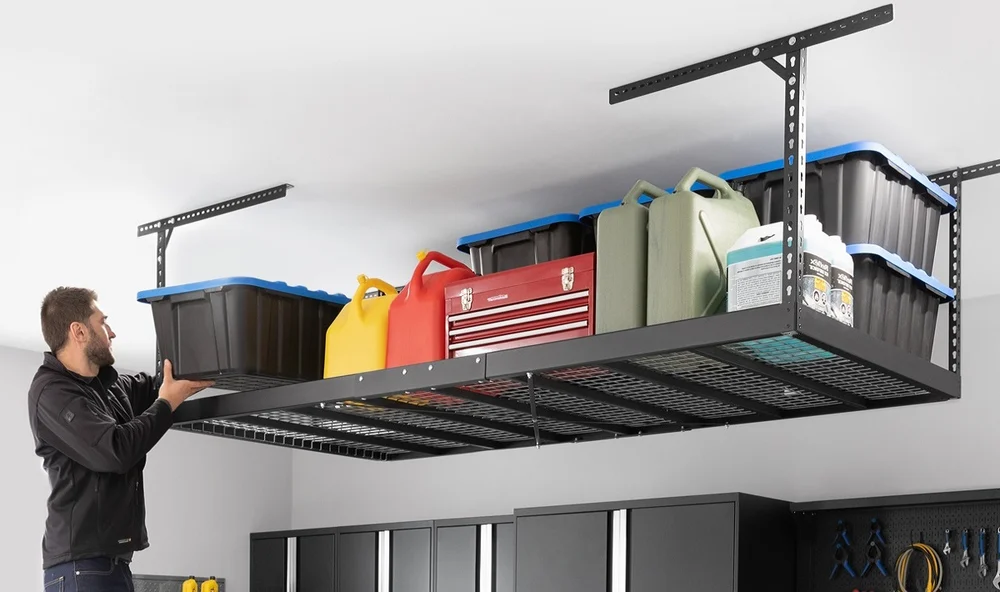
The floor is often the first casualty of a busy garage. Bins collect beside the car, ladders lean in corners, and seasonal décor takes over space meant for projects, parking, or simply getting out the door without stepping around clutter. Well-planned garage overhead storage solutions change that equation by putting rarely used belongings where they belong: safely up and out of the way. Incorporating efficient garage overhead storage will help maximize your space.
For homeowners who want a garage to feel as considered as the rest of the home, overhead storage is more than a place to stack totes. It is a way to reclaim valuable square footage, protect what you keep, and create room for you to breathe.
Why the Ceiling Is Your Garage’s Most Useful Open Space
Most garages have a large volume of unused air above the vehicles. That space is especially valuable because it can hold items you need to keep but do not need every week: holiday decorations, camping equipment, luggage, coolers, archived household records, and sports gear between seasons.
By leveraging garage overhead storage, you can enhance your garage’s functionality and ensure everything is within reach yet out of the way.
Moving these items overhead improves the way the entire garage functions. Floor space becomes available for vehicles, a workbench, bikes, or wall-mounted equipment. More importantly, the things you reach for often can be placed at a comfortable height rather than buried behind bins that have not moved in years.
There is a practical limit, however. Overhead storage should support occasional-access belongings, not become a catch-all for everything that does not have a home. If an item is used every few days, it is usually better suited to cabinetry, wall storage, or an accessible shelf. The goal is not to store more indiscriminately. It is to give every category a sensible place. When investing in a complete garage renovation, getting bulky items off the ground is just the beginning. To maximize your home’s potential, overhead racks should be paired with cohesive garage storage cabinets for your daily items, all anchored by a professional garage floor coating that instantly elevates the room’s aesthetic. Approaching the space as a complete makeover rather than just adding single retail pieces ensures every element works together seamlessly.
Garage Overhead Storage Solutions Start With the Right Questions
The best system is shaped by how your household actually lives. Before choosing a rack or lift, consider what you need to store, how often you use it, and what must still fit below it. A garage that parks two SUVs needs different clearances than a garage used primarily as a workshop or fitness area.
Measure for clearance, not just ceiling height
A high ceiling can make overhead storage possible, but height alone does not determine the right layout. The system must leave adequate clearance above parked vehicles, garage door tracks, openers, lighting, sprinklers, and access paths. It also needs to account for the height of the storage bins themselves.
A professional design considers the full room, rather than adding a rack to the first open section of ceiling. This protects daily usability. You should be able to open the garage door, park comfortably, and retrieve stored items without creating a new obstacle course.
In particular, garage overhead storage is ideal for seasonal items that are not frequently used, offering both safety and convenience.
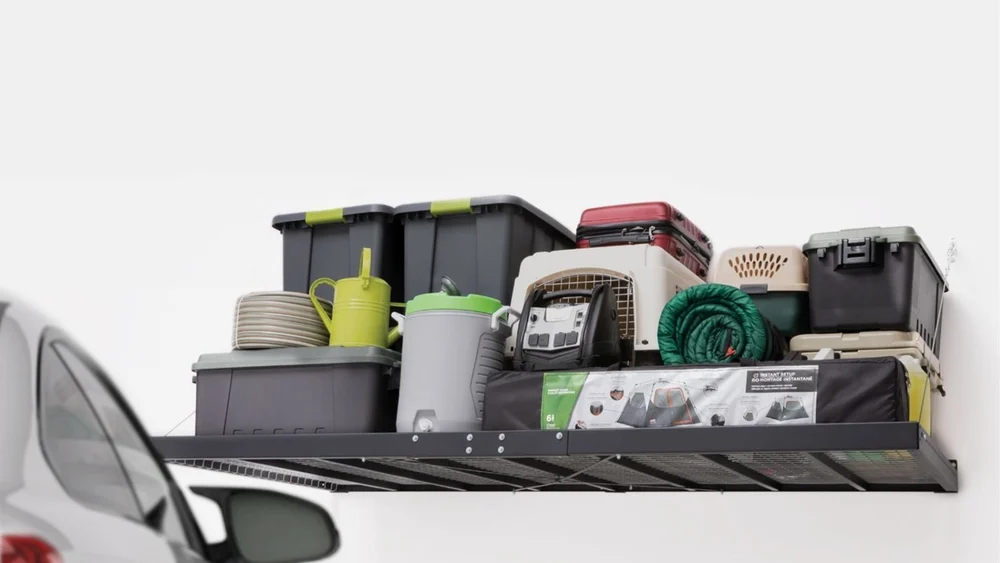
Ensure your garage overhead storage allows for safe access, especially when retrieving items regularly.
Sort belongings by frequency and weight
Overhead storage works best for lightweight to moderately heavy items stored in durable, labelled containers. Keep the heaviest items lower whenever possible, and do not place loose, awkward, or fragile objects above a vehicle or walkway.
Seasonal categories are ideal candidates. Winter holiday décor, patio accessories, camping supplies, and outgrown children’s gear can move up together. Clear or consistently labelled bins make it easier to find what you need without pulling down every container to inspect it.
Look for garage overhead storage systems that provide a balance between accessibility and efficiency.
Plan around safe access
A storage rack is only useful if you can access it safely. Think about where a ladder can be positioned and whether there is enough open floor area to use it. If regular lifting is not realistic for your household, a ceiling-mounted storage lift may be a better option for certain items.
When designing your overhead system, it is important to understand the different structural frameworks available. Avoid the temptation to buy indiscriminately; the hardware you choose dictates the safety and functionality of your space.
The Best Garage Storage Options
When shopping for ceiling racks, you will likely encounter budget-friendly options online. While the price point is appealing, these units typically rely on thinner, lower-grade metal. Because the materials are inherently weaker, manufacturers compensate by requiring more support legs and brackets. This not only makes installation far more complicated but also results in a cluttered, visually messy framework.
Consider motorized garage overhead storage lifts for convenience and ease of access to your stored items.
Wall-Mounted, Ceiling-Supported Shelving
For maximizing perimeter space, such as above windows, in corners, or over garage door rails, hybrid wall-mounted shelves with ceiling suspension are an exceptional choice. Designed for maximum space efficiency, these systems offer versatile installation. You can mount them at any wall height and link multiple shelves end-to-end to wrap around your garage, or stack them vertically for multi-level organization.
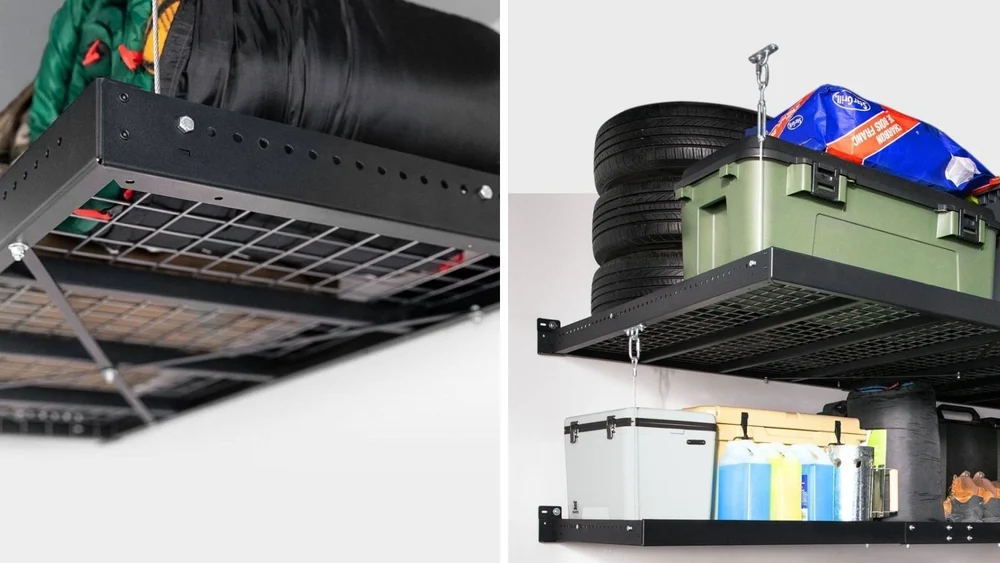
Smart design of garage overhead storage can help in keeping your space organized and visually appealing.
Heavy-Duty Ceiling Racks
If you have high ceilings and need to suspend bulkier items directly overhead, heavy-duty ceiling-mounted racks are the ideal solution. Designed to mount directly to wood studs or engineered joists, quality racks utilize elongated mounting brackets to navigate irregular joist spacing easily. Racks are adjustable to take full advantage of your space while clearing obstacles like doorways and rails.
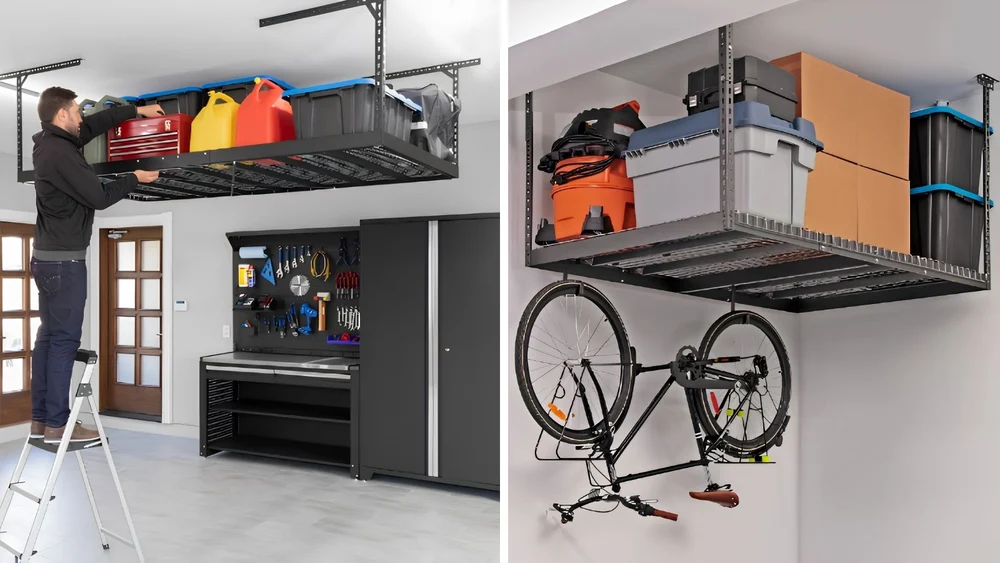
Heavy-duty options for garage overhead storage are available for those needing to store bulkier items safely.
Motorized or Manual Lifts
Lifts offer another approach. They are useful when retrieval needs to be easier or when the stored category is too cumbersome to manage on a ladder. Their trade-off is pricing, smaller weight limits, and complexity.
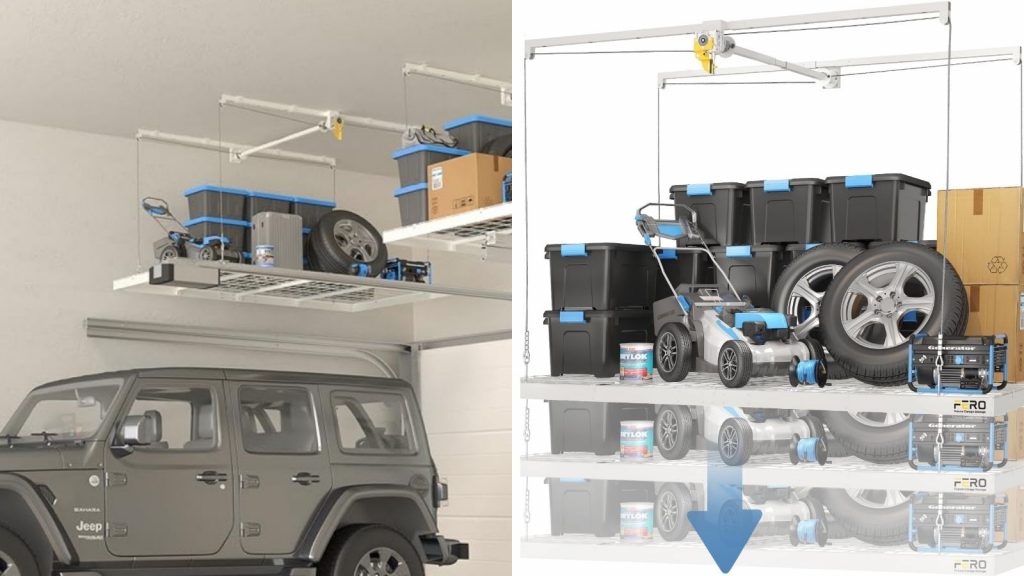
Ultimately, garage overhead storage allows you to reclaim your garage space, making it more functional and enjoyable.
The Details That Make Overhead Storage Look Considered
An overhead system can be technically functional and still make the garage feel crowded. Visual restraint matters, especially in a space that connects directly to your home. Matching bins, consistent labels, aligned rack placement, and clear zones help the ceiling storage read as part of the design rather than an afterthought.
Avoid overfilling the system. Leaving a little visual breathing room makes it easier to identify categories and reduces the temptation to pile items on top of the intended storage area. It also gives you capacity for the small changes that come with family life, hobbies, and new equipment.
Lighting deserves attention as well. Ceiling storage can cast shadows over work areas or reduce light near the garage door. A thoughtful layout protects existing fixtures and can incorporate task lighting where it will make daily routines easier.
Installation Is Where Safety and Performance Meet
Overhead systems carry weight above people, vehicles, and belongings, so installation should never be treated as a minor detail. The rack or lift must be mounted to suitable structural framing, with hardware and load ratings appropriate to the system and the items being stored. Drywall alone is not a mounting surface for a loaded overhead unit.
Load limits should be respected even when a rack appears capable of holding more. Weight should be distributed evenly, and containers should be secured and kept within the rack’s boundaries. Periodic checks are sensible, particularly after moving, adding items, or noticing any change in the structure or hardware.
Professional installation also allows the storage plan to be coordinated with cabinetry, wall systems, lighting, vehicle clearances, and the garage door mechanism from the beginning. At Orga Spaces, the design process begins with a consultation and 3D presentation, so homeowners can see how ceiling storage will work within the complete garage before installation begins.
A Better Garage Starts With What You Take Off the Floor
The greatest benefit of overhead storage is not simply that it creates more room. It changes how the garage supports your day. When sports equipment has a zone, seasonal bins are contained, and the floor is clear enough to park and move freely, the space feels calmer the moment you arrive home.
Start by identifying the belongings you would not miss for a month, then imagine them stored safely above rather than underfoot. That one decision can create the space for a garage that works harder, looks better, and gives the rest of your home a little more room to breathe.