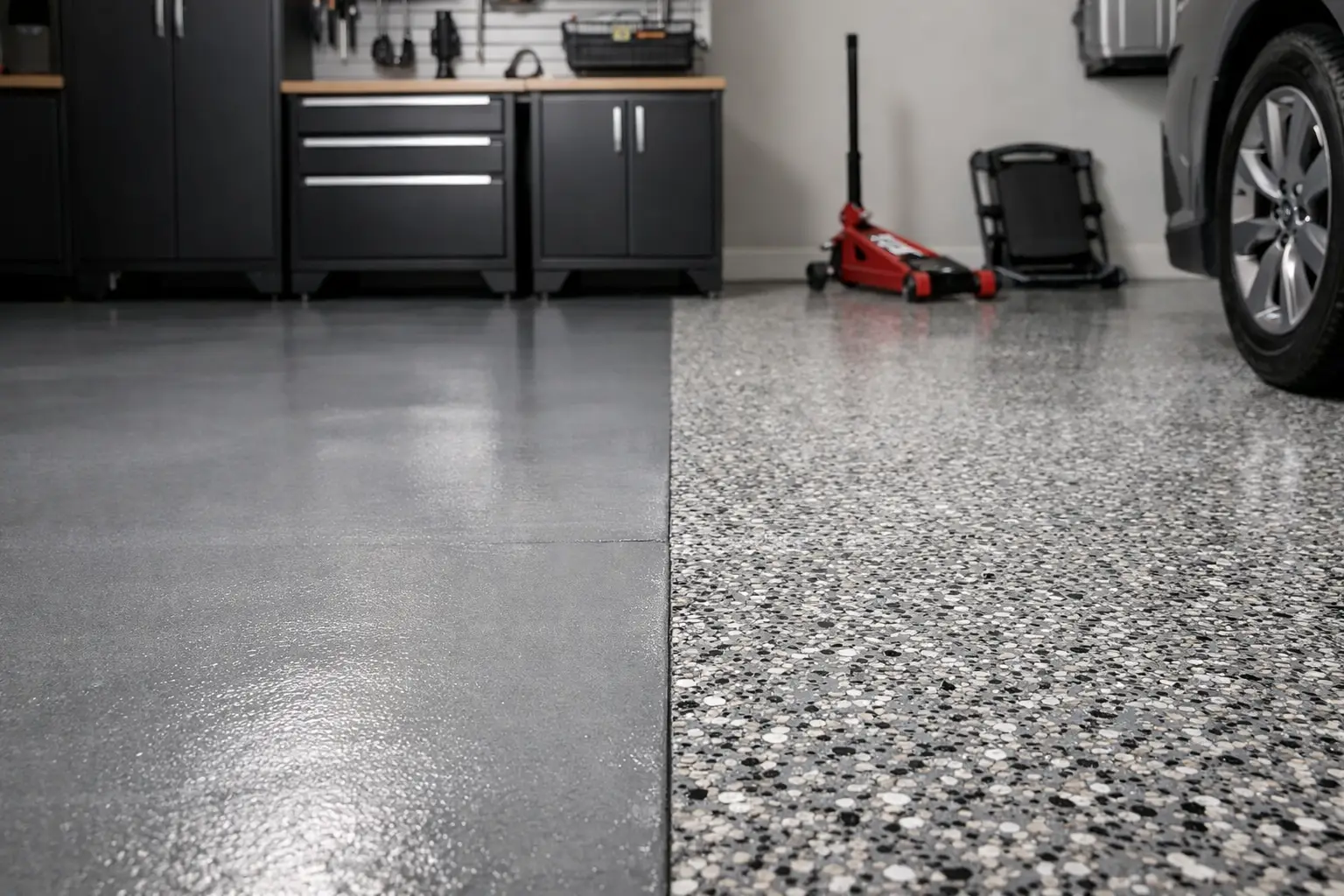
A garage floor usually tells the truth about the whole space. If the concrete is dusty, stained, peeling, or cracked, even well-designed storage can feel unfinished. That is why the question of garage coating vs epoxy matters more than most homeowners expect. You are not just choosing a product – you are deciding how durable, polished, and low-maintenance your garage will feel every day.
For many people, epoxy is the only term they know. It has been used for years, and it is still widely marketed as the standard for garage floors. But in practice, “garage coating” often refers to newer, higher-performance systems that go beyond traditional epoxy, especially in residential garage renovations where appearance, speed, and longevity all matter.
Garage coating vs epoxy: what is the actual difference?
Epoxy is a specific type of resin-based floor finish. It is applied over concrete to create a harder, more attractive surface than bare slab. A garage coating, on the other hand, is a broader category. It can include epoxy, but it can also refer to polyurea, polyaspartic, or multi-layer systems designed for better performance.
That distinction matters because many homeowners compare “epoxy” to “garage coating” as if one is a premium upgrade and the other is a basic option. In most cases, that is exactly what is happening. Traditional epoxy is one coating type. Premium garage coating systems typically combine several materials, each chosen for a specific job, from adhesion and flexibility to UV stability and wear resistance.
If your goal is simply to cover concrete cheaply, epoxy may seem good enough. If your goal is to create a finished garage that feels clean, intentional, and built to last, the conversation usually shifts toward advanced coating systems.
Why epoxy became popular
Epoxy earned its reputation for good reasons. It improved on plain concrete in a visible way. It added colour, some stain resistance, and a cleaner look. Compared with an untreated garage floor, it was a major step up.
It also became popular because it was relatively familiar. Contractors and homeowners knew the term, and do-it-yourself kits made it feel accessible. For a long time, that familiarity helped epoxy dominate the category.
The problem is that popularity and best performance are not the same thing. Many epoxy floors look fine at first, then begin to show their limits. Hot tire pickup, yellowing, peeling, and wear in high-traffic areas are common complaints. In a garage that sees vehicles, tools, bikes, storage movement, and changing temperatures, those weaknesses become harder to ignore.
Where traditional epoxy tends to fall short
The biggest issue with epoxy is not that it always fails. It is that its performance can be inconsistent, especially in residential settings where prep quality varies and sunlight enters through open doors or front-facing exposure.
Epoxy is generally less UV stable, which means it can amber or yellow over time. If your garage gets natural light, that shift can be noticeable. It also cures more slowly, which extends installation time and increases the chance of dust or debris affecting the finish while it sets.
Another concern is brittleness. Concrete naturally expands and contracts slightly, and garages deal with temperature swings, vehicle weight, and impact. Traditional epoxy can be less forgiving under those conditions, which may lead to cracking or delamination if the slab was not prepared properly.
Then there is the visual issue. Many lower-cost epoxy jobs have a thin, painted look. They cover the floor, but they do not necessarily elevate the room. For homeowners investing in cabinetry, wall storage, and a more refined garage design, that difference matters.
What a premium garage coating system does better
A high-quality garage coating system is usually built in layers, and that is where the performance difference becomes clear. Rather than relying on one product to do everything, the system uses the right material at each stage.
A professional installation may begin with diamond grinding to properly prepare the concrete and open the surface for adhesion. Cracks are repaired before coating begins. A polyurea primer or base coat can then bond tightly to the slab, followed by a full vinyl flake broadcast for texture, coverage, and visual depth. The final polyaspartic top coat adds durability, chemical resistance, UV stability, and easier maintenance.
This kind of system is designed for real life. It stands up better to tire traffic, household chemicals, moisture, and daily wear. It is also more visually complete. Full flake coverage creates a richer, more finished appearance than a thin roll-on coating, helping the entire garage feel cleaner and more intentional.
Garage coating vs epoxy on looks, durability, and upkeep
If you compare the two side by side, the differences usually come down to three things: how they look after installation, how they age, and how much effort they demand over time.
On appearance, a premium coating system usually wins. It has more texture, more design polish, and better visual consistency across the floor. That matters in a modern garage renovation, where the floor is not background. It is part of the room.
On durability, advanced coatings also tend to have the edge. They are typically more resistant to stains, abrasions, impacts, and chemical spills. They also handle sunlight better, which helps preserve the original look.
On maintenance, the gap widens further. A professionally installed coating system with a quality top coat is easier to sweep, easier to mop, and less likely to hold onto grime. When the floor sheds dust less and cleans up faster, the whole garage becomes more usable.
The installation timeline matters more than people think
One detail homeowners often overlook is downtime. A garage is not just storage. It may be where you park, where your kids leave sports gear, where tools live, or where projects happen on weekends. Having that space out of commission for several days can be disruptive.
Traditional epoxy often requires a longer cure time. Some systems need several days before you can walk on them comfortably and even longer before parking a vehicle. Newer polyaspartic-based systems can often be installed in one day, which is a major advantage for households that want the upgrade without a drawn-out process.
That speed does not just make life easier. It also reduces the risk of dust contamination and helps the project feel more controlled from start to finish.
Is epoxy ever the right choice?
Yes – in some cases. If budget is the primary concern and expectations are modest, epoxy can still be a reasonable option. It may also suit a low-use garage that sees minimal sunlight and little heavy wear.
But that is not the same as saying it is the best option. For homeowners making a broader investment in their garage, epoxy often becomes the compromise choice rather than the smart long-term one. It may cost less upfront, but if the floor yellows, chips, or needs replacement sooner, the value equation changes.
This is especially true when the garage is being treated as an extension of the home rather than a neglected utility zone. Once you add custom cabinetry, overhead storage, and thoughtful layout design, a lower-grade floor can hold the whole space back.
The better question is how you want the garage to function
When clients ask about garage coating vs epoxy, the most useful answer usually starts with lifestyle, not chemistry. Do you want a floor that simply covers concrete, or one that supports a more elevated space? Do you need a quick cosmetic improvement, or are you building a garage that feels cleaner, sharper, and easier to maintain for years?
That is why premium homeowners tend to move toward high-performance coating systems. The decision is rarely about trend. It is about reducing future headaches while creating a space that feels complete.
For a custom garage renovation, the floor should work as hard as the storage plan. It should resist wear, clean up well, and hold its appearance through daily use. In that context, a polyaspartic-based system with proper prep and full flake coverage is often the stronger answer.
At Orga Spaces, floor coatings are approached as part of the full transformation, not an afterthought. That means professional surface preparation, premium materials, and a finish designed to complement the rest of the garage with the same level of care.
A well-finished garage floor changes how the whole room feels under your feet. Choose the option that helps you reclaim the space fully – not just for now, but for the way you want to live in your home.
Connect with an Orga Spaces consultant to choose a garage flooring system tailored to your needs.