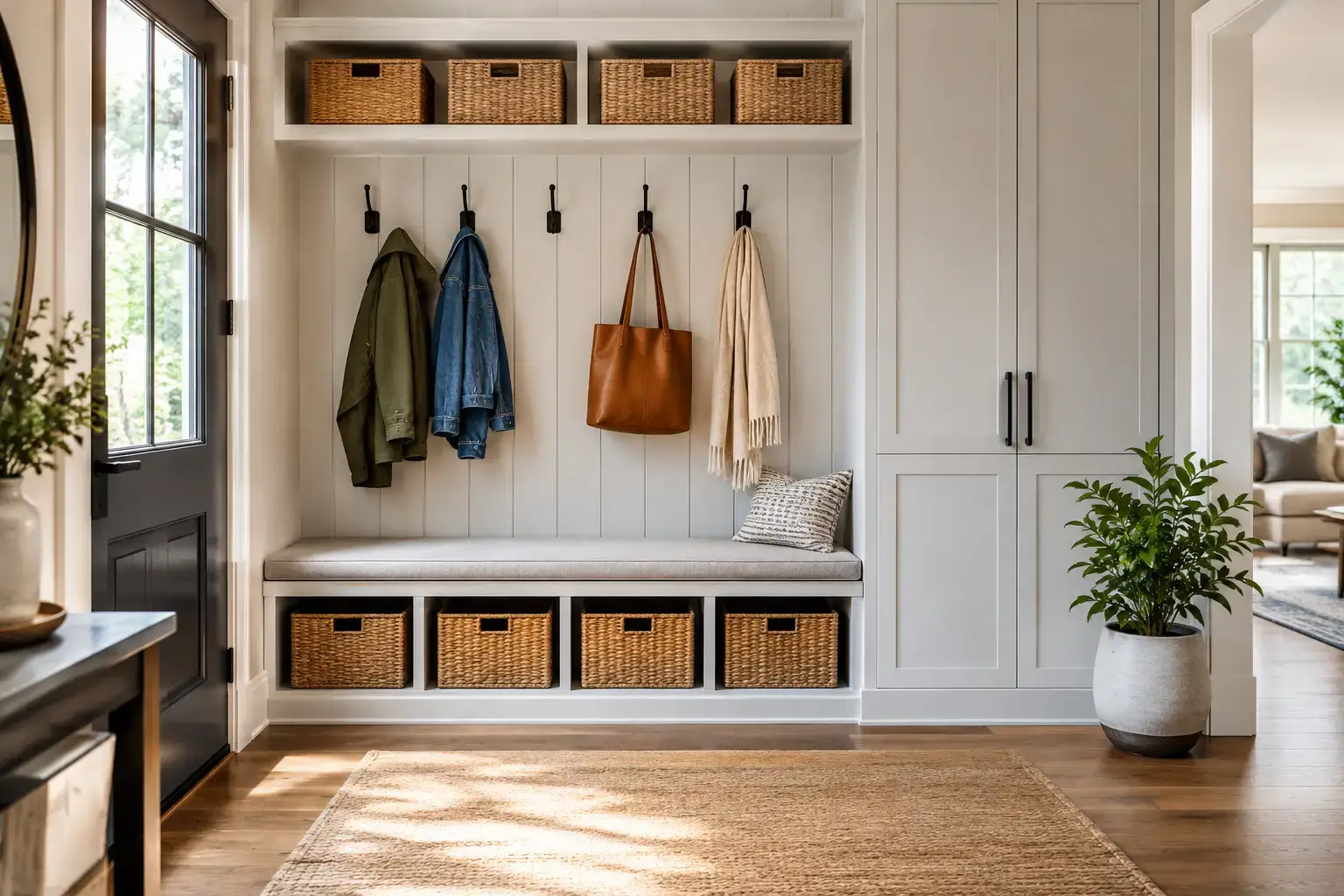
The entryway is where a well-planned morning can unravel in minutes. Shoes gather at the door, backpacks land on the nearest chair, keys disappear, and wet jackets become tomorrow’s problem. Learning how to organize family entryway traffic is less about finding more bins and more about giving every daily item a purposeful place.
For a busy household, the goal is not a picture-perfect foyer that no one can use. It is an entrance that handles real life gracefully: school mornings, sports practices, grocery runs, muddy shoes, guests, and the small pile of items waiting to leave the house. When the design supports those routines, the whole home feels calmer from the moment you walk in.
Start by Designing Around Your Family’s Arrival Routine
Before choosing furniture or storage accessories, notice what actually happens when everyone comes through the door. Which entrance does your family use most often? What gets dropped first? Are shoes removed immediately, or do they travel into the kitchen and bedrooms? The answers should shape the layout.
A front entry used primarily for guests may need a refined console, concealed storage, and a clean visual line. A garage-to-home entry used by children, pets, and active adults needs more durability and capacity. It may function as a compact mudroom, even if it was never designed as one.
Think in terms of a short sequence: arrive, unload, put away, and head inside. Each part of that sequence should require as little decision-making as possible. If a child has to open a heavy cabinet, reach above eye level, or guess where their backpack belongs, the floor will become the default storage system.
How to Organize Family Entryway Storage Into Zones
The most effective family entryways are organized by activity, not by category alone. A shoe rack can be useful, but it becomes far more effective when it sits exactly where shoes come off. A key tray works when it is positioned near the door, not across the room on a decorative table.
Create a distinct zone for each part of the arrival routine. In many homes, that means a landing zone for keys, mail, sunglasses, and wallets; a hanging zone for coats and bags; a shoe zone near the door; and a leaving zone for items that need to go out the next day.
For families with several people, assign each person a dedicated section whenever space allows. Individual hooks, cubbies, or shelves reduce the familiar question of whose jacket is whose and prevent one person’s gear from overtaking the entire entry. Children do especially well with storage they can reach independently.
A compact entryway may not accommodate a full built-in system, but it can still work hard. Wall-mounted hooks, a narrow bench with closed storage, and a slim tray or drawer for essentials can create a complete routine in a small footprint. In a larger space, custom cabinetry can conceal seasonal overflow while keeping the everyday essentials visible and accessible.
Keep daily items open and extras concealed
Open storage encourages fast put-away habits. Hooks, lower shelves, and cubbies are ideal for the items your family uses every day. They also make it easy to see when a space needs a quick reset.
Closed storage is better for visual calm. Use drawers, cabinet doors, or lidded baskets for sunscreen, umbrellas, pet supplies, spare gloves, reusable shopping bags, and other items that are useful but not attractive. The balance matters: too much open storage can look busy, while too much hidden storage can make daily routines feel inconvenient.
Choose Materials That Can Handle Real Life
A family entryway works harder than almost any other area of the home. It needs finishes that can stand up to dirt, moisture, scratches, and frequent cleaning without looking worn within a season.
Choose hooks that are securely mounted and substantial enough for heavy backpacks and winter coats. Select benches and cabinetry with durable, wipeable surfaces. If your household removes shoes at the door, a washable runner or mat can protect flooring while adding warmth and texture to the space.
For homes where the garage is the main family entrance, consider the transition as part of the larger organization plan. A clean, durable garage floor and properly planned wall storage can prevent sports equipment, outdoor shoes, and tools from migrating into the home. The most polished entryway cannot stay organized if the spaces feeding into it are in constant overflow.
Give Every Item a Limit
Storage alone does not solve clutter. A cabinet can hide an impressive amount of disorder, but it cannot tell you what deserves to stay. The entryway becomes manageable when each category has a natural limit.
Keep only the shoes, coats, and bags that are currently in rotation near the door. Out-of-season footwear, formal coats, and duplicate accessories should live elsewhere. This is particularly helpful in Dallas-Fort Worth homes, where weather can shift quickly but most households do not need every cold-weather item available year-round.
Mail deserves its own boundary, too. Without one, it spreads across counters and tables almost immediately. A small tray for incoming mail is enough if it is emptied regularly. If you need more structure, create two simple sections: one for action items and one for filing. Avoid turning the entryway into a permanent paperwork station.
Build a Reset Routine That Takes Five Minutes
Even a beautifully designed entryway needs a rhythm of maintenance. The difference is that a thoughtful system makes that maintenance quick instead of overwhelming.
A five-minute evening reset can restore the space before the next morning begins. Return shoes to their assigned shelves, hang bags and coats, clear the landing tray, and move anything that belongs elsewhere into the room where it will be handled. This is not deep cleaning. It is simply closing the day with the entry ready for the next arrival.
A weekly reset gives you a chance to remove stray items, wipe surfaces, sort mail, and check whether the shoe area has become overloaded. If the same clutter keeps returning, treat it as design feedback. Perhaps you need more hooks, a larger basket for pet gear, or a more convenient location for school bags. Good organization evolves with the household.
Make the Entryway Feel Considered, Not Clinical
Function should lead the plan, but the entryway also sets the emotional tone for the home. It is the first space your family sees after a long day and the first impression guests receive. A well-organized room can still feel warm, personal, and refined.
Use a bench with a comfortable cushion, a framed piece of art, or a mirror that reflects light into a darker hallway. Keep decorative choices intentional and limited, especially in a high-traffic area. One beautiful basket is more effective than several mismatched containers competing for attention.
Custom storage becomes especially valuable when standard furniture leaves awkward gaps or fails to serve the way your family lives. Tailored cabinetry can combine seating, shoe storage, tall coat compartments, charging drawers, and concealed utility storage in a single cohesive design. Rather than asking your routine to fit generic furniture, the space is built around your routine.
At Orga Spaces, this kind of planning begins with understanding how a household moves through its home, then translating those habits into storage that looks as considered as it feels useful. The right entryway does more than contain clutter. It gives everyone a reliable place to arrive, reset, and move forward with a little more room to breathe.